
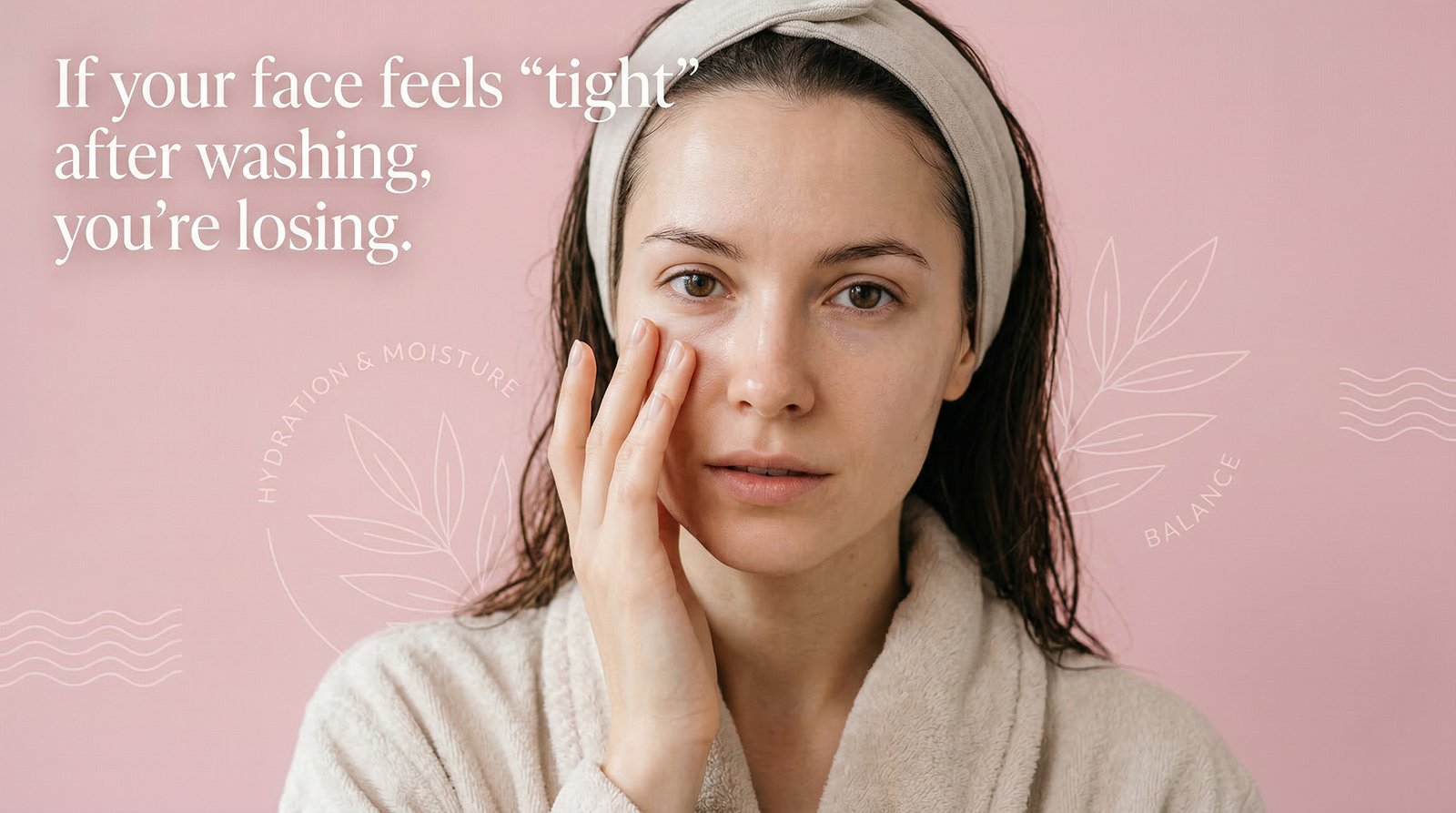
Your cleanser isn’t a neutral step. It’s either setting your skin up for everything that follows or quietly dismantling the one thing that matters most. Here’s how to tell the difference.
The Great Cleanse Crisis
Your 10-step routine isn’t helping your skin. It’s exhausting it.
And the worst part? The damage starts before you even get to the serums. It starts at the sink, with the very first thing you put on your face.
Most people spend 30 seconds on their cleanser and three hours debating which niacinamide to layer on top. That’s completely backward. Because if you’re cleansing wrong wrong formula, wrong frequency, wrong assumption about what “clean” means nothing else in your routine can fix what happens next. The cleanser debate has mostly been about foam vs. oil. But the one that actually matters for the skin most of us have right now, in this climate, in 2025, is milk vs. gel.
One of them is probably working against you. And you won’t know which one until you understand what your skin is actually trying to do.
The Version of "Clean" That's Breaking Your Barrier Down
That tight, squeaky feeling after washing your face? A lot of people read that as “clean.” It isn’t. It’s your skin in distress.
What you’re actually feeling is the aftermath of surfactants the cleansing agents in most gel and foaming formulas stripping not just dirt and sebum, but the lipids that hold your barrier together. Ceramides. Cholesterol. Free fatty acids. The three-part structure that keeps moisture locked in and irritants locked out. This isn’t a minor inconvenience. Your skin barrier functions as a lamellar lipid matrix, and when that matrix gets disrupted repeatedly, daily, twice daily transepidermal water loss (TEWL) increases. Your skin loses moisture faster than it can produce it. Research published in the Journal of Investigative Dermatology confirms that elevated TEWL directly correlates with inflammation, increased sensitivity, and compromised recovery from topical treatments.
In other words: you’re washing off the thing your moisturizer is trying to rebuild. Every single morning and night.
The Science, Briefly
The skin barrier is made up of ceramides (50%), cholesterol (25%), and free fatty acids (15%). When surfactant-heavy cleansers disrupt this ratio, TEWL rises and the skin enters a cycle of dehydration and reactive oil production. A landmark study in the British Journal of Dermatology found that even “mild” surfactants can alter skin pH and reduce ceramide levels after consistent use which means the problem accumulates invisibly.
Milk Cleansers Aren't Just "Gentle." They're Structurally Different.
Here’s the real difference between a milk and a gel cleanser: it’s not just texture. It’s chemistry.
Gel cleansers even the ones marketed as “gentle” are typically water-based formulas relying on surfactants like sodium laureth sulfate or cocamidopropyl betaine to do the cleansing. The surfactant binds to oil, lifts it off the skin, and rinses away. The problem is it doesn’t stop there. It also binds to your skin’s own lipids.
Milk cleansers work differently. Most use a combination of emollients, micellar technology, or fatty-acid-based ingredients that dissolve surface impurities without the same charge-based lipid disruption. They clean by affinity like attracts like rather than by chemical aggression.
That’s not a marketing distinction. That’s a formulation one.
The caveat: milk cleansers can leave a residue on oilier skin types, and they’re not always sufficient for heavy SPF, silicone-heavy makeup, or end-of-day urban pollution. This is where double-cleansing done right comes in. But we’ll get to that.
Your Cleanser Is Quietly Destroying the Bacteria That Protect You
Wait bacteria on your skin is a good thing?
Yes. Your skin hosts a complex ecosystem of microorganisms predominantly Staphylococcus epidermidis, Cutibacterium acnes, and various Corynebacterium species that actively support your skin’s immune response, pH balance, and barrier integrity. This is called the skin microbiome, and it is not a bonus feature. It’s infrastructure.
According to research published in the Journal of Investigative Dermatology (via NIH/PMC), disruption of the skin microbiome is associated with conditions including atopic dermatitis, acne, and rosacea. The common thread? Aggressive cleansing that alters the pH environment in which beneficial bacteria thrive.
Your skin’s ideal pH is between 4.5 and 5.5 mildly acidic. Most foaming gel cleansers have a pH of 7 to 9. Every time you use one, you’re temporarily alkalizing your skin surface. Beneficial bacteria struggle in alkaline environments. C. acnes, ironically, does not.
So, if you’ve been breaking out despite a “clean” routine or your skin feels persistently inflamed without an obvious cause your cleanser’s pH might be the thing no one has told you to check.
Worth Noting
A 2007 study in the International Journal of Cosmetic Science found that skin treated with syndet (synthetic detergent) cleansers at pH 5.5 showed significantly better barrier recovery and reduced TEWL compared to soap-based cleansers at pH 9-10. The conclusion wasn’t that all cleansers are bad it was that pH-matched formulas cause measurably less damage. Milk cleansers and micellar formats tend to sit closer to that 5.5 target.
Hydration Isn't Moisture. And Confusing the Two Is Making Your Skin Worse.
This is the one that trips almost everyone up.
Hydration refers to water content in the skin cells. Moisture refers to the lipids the fats that keep that water from evaporating. They are not the same thing. And you cannot fix one by throwing more of the other at your skin.
If your barrier is compromised which, as we’ve established, your cleanser might be doing adding a hyaluronic acid serum on top won’t save you. Hyaluronic acid is a humectant. It draws water toward itself. But if your barrier can’t hold that water in, it will pull moisture from the deeper layers of your skin and release it into the air. On a dry, air-conditioned, or climate-variable day, you can actually end up more dehydrated after applying HA than before.
This is why some people complain that their “hydrating” serum makes their skin feel tight by midday. It’s not a bad product. It’s a sequencing and barrier problem.
The fix isn’t more hydration steps. It’s sealing with ceramides, fatty acids, squalane, or occlusive-light ingredients after any water-attracting actives. In the right order. With the right formula underneath doing the barrier prep.
At this point, your skin doesn’t need another serum. It needs a cleanser that doesn’t undo the work before it starts. The Minimals cleansing range is formulated at skin-compatible pH levels milk textures for compromised and dry skin, low-surfactant gels for combination and humid climates so your barrier walks into the rest of your routine intact, not rebuilt from scratch.
Layering Actives Isn't a Routine. It's an Inflammation Loop.
You have retinol, niacinamide, vitamin C, AHA, BHA, and a peptide moisturizer. And your skin has never looked worse.
This isn’t a coincidence.
Each of those actives has a job. The problem is that most of them require an intact, stable skin surface to work properly. Retinol penetrates best when the lipid matrix is intact to regulate its absorption rate. Niacinamide’s anti-inflammatory action is most effective when it’s not competing with background irritation from compromised barrier tissue. Vitamin C oxidizes faster and penetrates unpredictably on skin with elevated TEWL. When you combine multiple actives on a repeatedly cleansed, mildly disrupted barrier, you don’t get synergy. You get inflammation that doesn’t announce itself just sits there, sub-clinically, making your skin reactive, your results inconsistent, and your routine feel like it’s “not working.”
A 2022 review in Dermatology and Therapy (via NIH/PMC) on multi-active skincare regimens found that combination routines without a foundational barrier-support phase produced significantly higher rates of reported sensitivity and reduced tolerability of actives even low-concentration ones. The recommendation from the researchers was consistent: repair first, treat second.
The cleanser is step one of barrier repair. If you’re skipping that logic and jumping straight to actives, you’re applying expensive products to compromised infrastructure. It’s like painting a wall with holes in it and wondering why it looks rough.
So, Who Actually Needs a Gel, and Who's Been Fooled Into Thinking They Do?
The gel cleanser became the default because it feels like it’s doing something. The lather, the rinse, the tight skin. All of that reads as “thorough.” And for some skin, at certain times, a low-surfactant gel is genuinely the right choice.
But here’s the reality breakdown:
Your skin feels tight within 20 minutes of cleansing. You live in a dry or variable climate. Your skin is reactive, flaky, or constantly “sensitive.” You’ve been told your skin is acne-prone but it also feels dehydrated at the same time. You’re using retinoids or active treatments that already challenge your barrier. You’re over 30, or your sebum production has decreased for any reason.
You have genuinely oily skin with large pores that remain oily throughout the day. You live in a hot, humid climate (Karachi in August, we see you). You’re using heavy-coverage products or high-SPF sunscreens that require emulsification. Your skin never feels tight post-cleanse it rebalances quickly.
The honest caveat: most people who think they need a gel cleanser because they’re “oily” are actually experiencing reactive sebum production oil as a compensatory response to a stripped barrier. If your skin is oily 30 minutes after washing, that’s your barrier trying to protect itself from over-cleansing. A milk cleanser, consistently used, often normalizes that response within a few weeks.
If Your Routine Feels Complicated, That's the Problem.
Step back from your shelf for a second and count your steps. If it’s more than five, one of two things is true: either you’re addressing multiple distinct concerns in a genuinely deliberate sequence or you’ve been collecting products the way anxiety collects tasks. Something to do. Something to optimize. Something to fix.
Skincare marketing is extraordinarily good at making you feel like the answer is always one more product away. A brighter serum. A deeper exfoliant. A resurfacing mask. A recovery mask to recover from the resurfacing mask.
This is how skin gets caught in inflammation loops cycles of active treatment followed by barrier disruption followed by sensitivity followed by more product to address the sensitivity, which introduces more actives, which causes more disruption. The loop keeps you buying. It doesn’t keep your skin healthy.
The cleanser is where the loop either starts or stops. A formula that respects your barrier’s lipid matrix, maintains a skin-compatible pH, and actually removes what needs to be removed without collateral damage? That’s not a starting point you work from. That’s a foundation you build on.
Everything else in your routine either sits on that foundation or it doesn’t sit at all.
The Minimal Routine That Actually Works
Four steps. That’s the ceiling. If you’re treating a specific concern active acne, hyperpigmentation, early signs of aging you can add one targeted treatment in the middle. One. Not a stack.
Milk cleanser for compromised, dry, reactive, or normal-to-dry skin. Low-surfactant, pH-balanced gel for oily or humid-climate skin. Not both in one day unless double-cleansing in PM.
Shop Minimals Cleansers
One serum. One function. Niacinamide for congestion and oil regulation. Ceramide serum for barrier repair. Vitamin C in AM for oxidative defense. Not all three at once.
A ceramide-rich, occlusive-balanced moisturizer that seals in your treatment layer and rebuilds what cleansing removed. This step is not optional. This step is the point.
Broad-spectrum SPF 30–50, every morning, regardless of whether you’re going outside. UV damage is cumulative, silent, and the single largest driver of premature barrier aging.
Morning double-cleansing is almost never necessary. You weren’t producing heavy pollution in your sleep. Water, or a light milk pass, is enough unless you’re sweating heavily at night or using occlusive overnight treatments.
Evening double-cleansing is sometimes necessary specifically if you’ve worn physical SPF, silicone-based makeup, or long-wear products. In that case: oil or balm first to dissolve, then your milk or gel cleanser as the second pass. Both cleansers should be gentle. Neither should strip.
Common mistakes we all make
the most common mistake is prioritizing expensive active treatments while sabotaging the skin at the very first step: cleansing.
Specifically, the post highlights three ways we get this wrong:
The “Squeaky Clean” Myth: We mistake a tight, “squeaky” feeling for cleanliness, when it’s actually a sign of a stripped and distressed skin barrier.
The Time Imbalance: We spend “three hours” debating which serums to layer but only 30 seconds choosing a cleanser, ignoring the fact that the wrong wash makes the rest of the routine useless.
Misreading Oily Skin: We use harsh gel cleansers to fight oil, not realizing the oil is often a “compensatory response” the skin overproducing sebum because it’s been stripped and is “scared.”
A Simple "Cleansing-Logic" Checklist
Frequently Asked Questions
Yes. That squeaky-clean sensation isn’t cleanliness it’s your skin in distress. It means your cleanser has stripped away the essential lipids (ceramides and fatty acids) that keep your barrier intact and moisture locked in.
Often, yes. Many “oily” skin types are actually dehydrated and overproducing oil to compensate for being stripped by harsh gels. Switching to a milk cleanser can normalize your sebum production within a few weeks.
If your barrier is compromised, humectants like Hyaluronic Acid can actually pull water out of your deeper skin layers and release it into the air (TEWL). You must always “seal” hydration with a ceramide-rich moisturizer.
Rarely. You don’t produce heavy pollution or grime while you sleep. For most people, a light pass with a milk cleanser or even just plain water is enough to keep the barrier rested and ready for the day.
It’s everything. Your skin is naturally acidic ($pH$ 4.5–5.5). Most foaming gels are alkaline, which kills beneficial bacteria and allows acne-causing bacteria to thrive. Keeping your pH balanced is your first line of defense against breakouts.
Closing thought
Your skin isn’t a surface to be scrubbed; it’s a living ecosystem to be managed. If you’ve been chasing results through an endless stack of serums while ignoring the damage done at the sink, it’s time to flip the script.
True “skinimalism” isn’t just about doing less it’s about doing the right things in the right order. By choosing a cleanser that respects your lipid matrix and a routine that prioritizes protection over aggression, you stop the cycle of inflammation. Stop over-complicating the process. Fix your foundation, respect your barrier, and let your skin finally do what it was designed to do: protect you.