
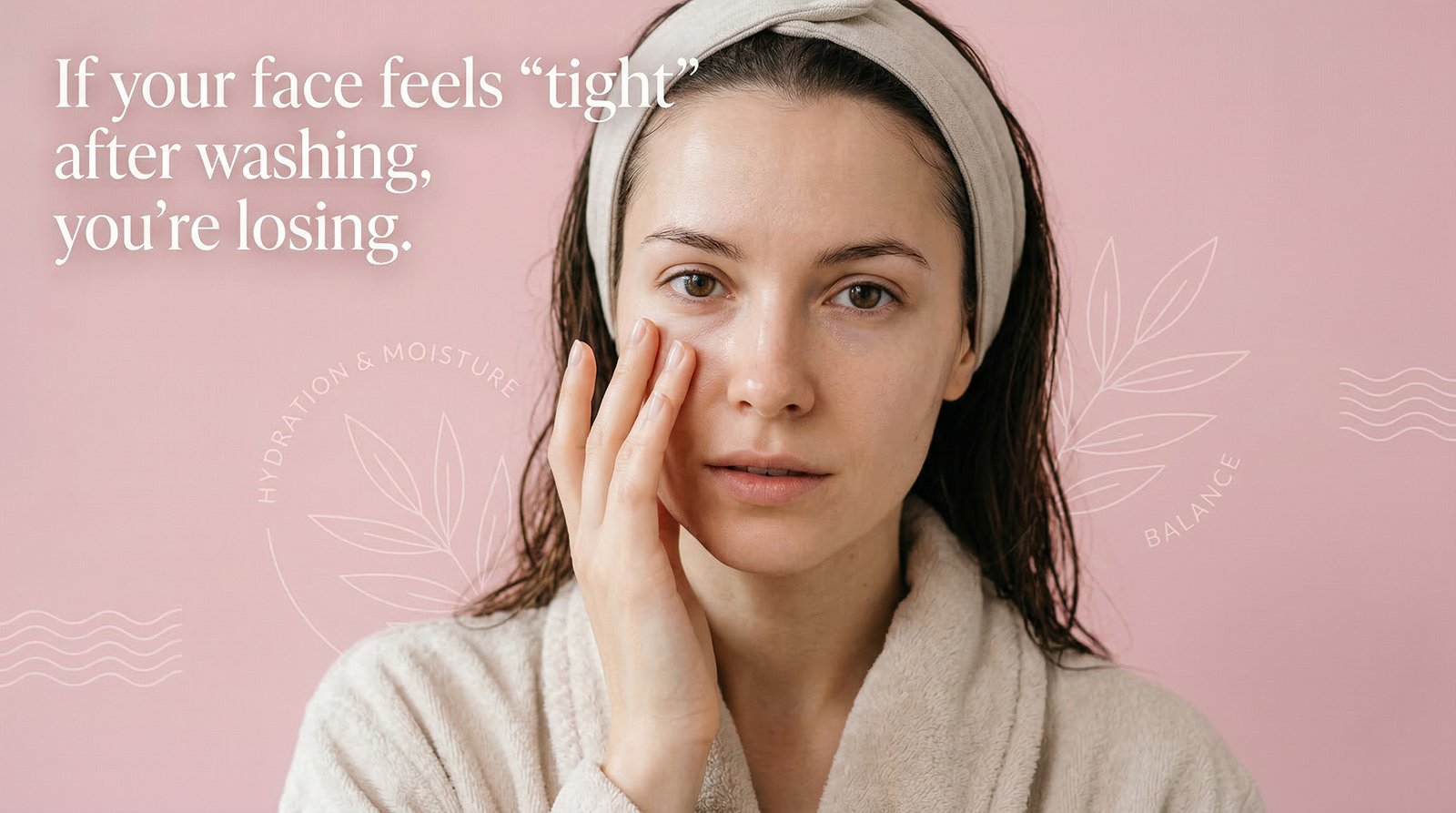
Stop punishing your skin for staying clean.
Your Soap is a Thief.
You wash your hands. A lot. Probably more than you realize. After the bathroom. Before eating. When you get home. After touching that railing on the bus in traffic. And every single time, your hands feel it. That tight, squeaky-clean pull. The dryness that creeps in by mid-afternoon. The cracks that show up around your knuckles when the weather shifts or the AC blasts in the office.
You blame the heat. The dust. The pollution. Maybe even “just aging skin.”
But what if the real culprit is sitting in your bathroom right now? That harsh bar or liquid soap that’s been quietly stripping your skin every time you do the right thing for hygiene. Your hands deserve better. Washing them shouldn’t feel like penance.
Why your current hand soap is quietly wrecking your skin barrier
The outermost layer of your skin the stratum corneum isn’t just dead cells. It’s a smart, living barrier built like brick and mortar. The “bricks” are corneocytes. The “mortar” is a precise mix of ceramides, cholesterol, and free fatty acids arranged in a lipid matrix. This matrix locks in moisture and keeps irritants out. It also controls transepidermal water loss (TEWL) the invisible evaporation of water from your skin. Most conventional hand soaps, especially the ones labeled “antibacterial,” “deodorizing,” or just cheap “fresh scent,” are built on strong surfactants like sodium lauryl sulfate (SLS) or alkaline formulas. These don’t just lift dirt and oil. They dissolve the lipid mortar.
Studies show traditional alkaline soaps significantly increase TEWL and skin erythema redness that signals ongoing barrier damage. The effects can linger for days.
Right after washing, your skin pH spikes, erythema peaks, and TEWL shoots up. That’s not “clean.” That’s compromised.
Your hands pay the price faster than your face because you wash them more often. No recovery time between insults.
The microbiome you didn't know you were murdering
Your skin hosts a delicate ecosystem of bacteria, fungi, and other microbes that help regulate inflammation, fight pathogens, and even support barrier repair.
Harsh soaps and frequent washing disrupt this balance. They don’t just remove “bad” bacteria they wipe out diversity. Lower microbial diversity on the hands correlates with more irritation and slower healing. Over time, this creates an inflammation loop. Damaged barrier lets more irritants in. Disrupted microbiome fails to calm things down. Your skin stays red, dry, reactive. You reach for more cream. Or stronger soap. The cycle continues. And those “kills 99.9% of germs” claims? Plain soap and water already handle most everyday threats effectively, especially enveloped viruses. Gentler cleansers can perform just as well without the collateral damage.
You don’t need to punish your skin to stay safe.
The myth of "squeaky clean"
That tight feeling after washing? It’s not proof it’s working. It’s proof your barrier just lost lipids and natural moisturizing factors.
Many people chase that stripped sensation because marketing trained us to associate it with clean. But hydration isn’t the same as moisture. Hydration refers to water content. Moisture involves the oils and lipids that prevent that water from escaping. Stripping one without replenishing the other leaves skin dehydrated and lacking moisture dry, flaky, and paradoxically oily as it overcompensates.
Wait, what? Yes. Over-cleansed skin often triggers more sebum production while still feeling tight. Your hands crack instead.
Why layering heavy creams afterward isn't fixing the root issue
After that harsh wash, you slather on lotion. Maybe one with fancy actives. But if the cleanser already extracted ceramides and raised TEWL, you’re playing defense on damaged ground.
Research on detergent-damaged skin shows that lipid supplements especially properly formulated ceramides can help reverse barrier dysfunction. But prevention beats repair. Applying moisturizer immediately after washing does reduce the spike in TEWL and pH. Yet the most effective approach is a cleanser that doesn’t cause the spike in the first place.
At “Minimals”, we approach this with barrier-first thinking. Your hand soap shouldn’t create the problem your moisturizer has to solve.
The counterintuitive truth about minimal hand care
Skinimalism isn’t about doing nothing. It’s about doing the essential things with formulas that respect biology instead of fighting it. For hands, that means a cleanser that removes dirt, oil, and microbes without dismantling the lipid matrix or crashing the microbiome. It means pH-balanced, sulfate-free surfactants that cleanse efficiently but leave enough of the good stuff behind. Or better ones that include supportive lipids so the wash itself supports repair.
Most “moisturizing” hand soaps still rely on heavy but temporary humectants that sit on top without integrating. A smarter formula works with the skin’s natural structure.
This is where skinimalism shines on hands: one product that cleans without compromise, so the rest of your routine can stay truly minimal.
If your routine feels complicated, that's the problem
Look at your sink. How many bottles fight for space? Face wash, hand soap, body wash, separate sanitizer, three creams because “this one is for daytime, this for night, this for cuticles.”
Your hands don’t need a 5-step protocol. They need consistency without irritation.
Frequent washing in humid-then-dry Karachi weather already stresses the barrier. Layering too many actives or products creates “inflammation loops” where each new ingredient has to fight the disruption caused by the last one. Simpler isn’t lazy. It’s strategic. Less disruption means faster visible calm fewer cracks, less redness, skin that actually holds onto moisture.
Your minimal hand-focused routine blueprint
Keep it to what actually matters. No more, no less.
Use a gentle, barrier-supporting hand wash. Look for one with mild surfactants, ceramides or lipid precursors, and no harsh stripping agents. Wash for the full 20 seconds when needed, but don’t overdo frequency just for the ritual. At “Minimals”, the hand cleanser is designed exactly for this no punishment, just effective removal that leaves the foundation intact. It feels like the opposite of most soaps: soft during the wash, calm afterward.
If your hands show specific issues persistent dryness, minor eczema flares add a targeted serum with ceramides, niacinamide, or soothing ingredients. But only after the cleanse has done its job without creating new damage. Most days, you can skip this.
Lock it in with a moisturizer rich in ceramides, cholesterol, and fatty acids to mimic your skin’s natural lipid matrix. Apply while skin is still slightly damp for better absorption the “moisture sandwich” effect. This step becomes lighter and more effective when your cleanser hasn’t stripped everything first.
In intense sun or pollution, a light broad-spectrum SPF on hands isn’t overkill, especially if you’re driving or outdoors a lot. But choose non-greasy formulas that won’t interfere with grip or feel sticky in the heat.
That’s it. Three core steps most days. Your hands recover. The routine stays sustainable even with Karachi’s demands commutes, office air-con, frequent ablutions.
What changes when you stop the punishment
Hands that don’t crack at the knuckles by Thursday. Cuticles that stay smooth instead of ragged. Less urge to reapply cream every hour because the barrier actually holds moisture. Skin that feels resilient, not reactive. And the quiet confidence that you’re not trading hygiene for comfort or comfort for hygiene.
The science backs this. Studies on ceramide-containing or lipid-supporting cleansers show they enhance barrier function rather than just avoiding damage. TEWL stabilizes. Erythema calms. Skin homeostasis returns faster.
You don’t need to choose between clean and comfortable.
Stop accepting dry, tight hands as normal
That post-wash tightness? It’s feedback. Your skin telling you the formula isn’t compatible with repeated use.
The industry pushed strong detergents and “powerful” antibacterials for decades because they foam dramatically and feel like they’re doing something aggressive. But aggressive isn’t intelligent. Intelligent cleansing respects the barrier while still getting the job done. It works with your microbiome instead of against it. It makes the daily necessity of hand washing neutral or even supportive.
At this point, your hands don’t need another heavy cream layered on top of damage. They need a cleanser that already considers the barrier during the wash itself.
“Minimals” built the hand wash with exactly that in mind: skinimalism applied where you need it most. Effective cleansing that doesn’t feel like punishment. Formulas that align with how skin actually works ceramide support, pH respect, minimal interference.
You wash your hands anyway. Make it count for your skin, not against it.
Start there. One change. Notice how the rest of your routine feels easier when the foundation isn’t constantly being eroded. Your skin isn’t high-maintenance. It was just being maintained poorly. Fewer products. Better choices. Hands that feel like they belong to someone who actually listens to what their barrier needs. Because washing your hands should keep you healthy without making your skin pay for it.
The "Clean" Checklist: Is Your Soap Helping or Hurting?
Frequently Asked Questions
Most “moisturizing” soaps are just aggressive detergents with a drop of oil added for marketing. The detergent still strips your lipid matrix before the oil can do anything. You aren’t moisturizing; you’re just failing to clean gently.
Not necessarily. Plain soap and water are highly effective at removing germs without the side effects. Antibacterial chemicals often disrupt your skin’s microbiome, leaving you more prone to irritation and inflammatory loops.
You’re treating the symptom, not the cause. If your soap is causing transepidermal water loss (TEWL), you’re essentially pouring water into a bucket with a hole in the bottom. Fix the wash, and you’ll find you need much less cream.
Look for “sulfate-free” on the label. Seek out formulas that include ceramides or glycerin to support the barrier while you cleanse. At Minimals, we believe a cleanser should leave your skin’s biological foundation exactly where it found it.
Yes. Hot water is a solvent; it melts the protective fats in your skin. Stick to lukewarm water to keep your barrier intact while still getting a thorough clean.
Closing thought
Your hands do the heavy lifting of your life especially in a city like Karachi, where the dust and heat never quit. They shouldn’t have to fight your soap, too.
The industry wants you to believe that effective hygiene requires aggression. It doesn’t. It requires intelligence.
When you stop treating hand washing as a chemical chore and start treating it as barrier maintenance, everything changes. You’ll stop reaching for the heavy creams every hour. Your knuckles will stop cracking. Your skin will finally have the space to do what it does best: protect you.
At “Minimals”, we don’t do fluff, and we don’t do punishments. We make products that respect your biology so you can get back to your life with skin that feels like skin not paper.
You don’t need more steps. You just need a better start.