
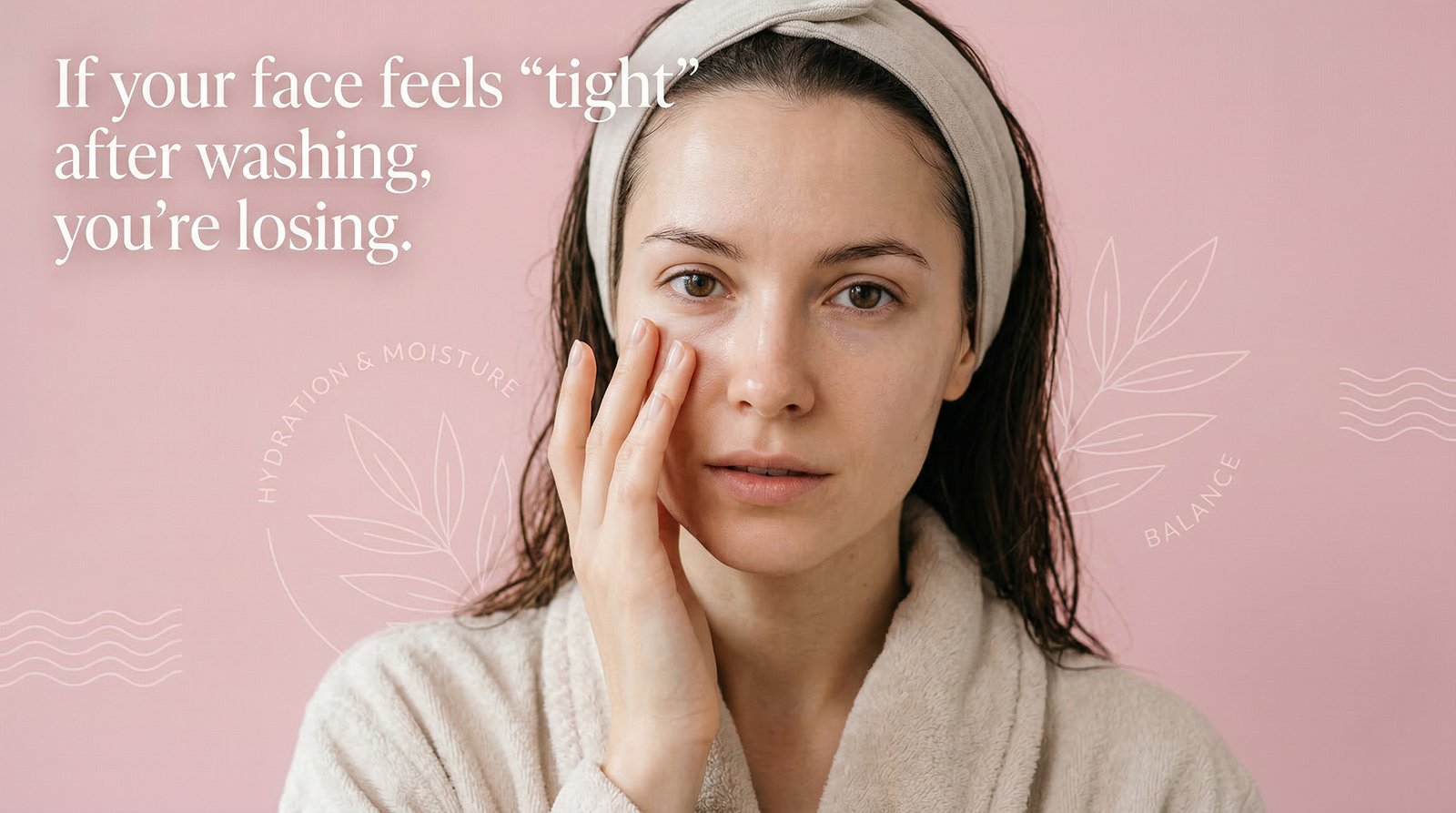
Unlike your face, the skin on your hands lacks the sebaceous glands needed to replenish lost oils. Every wash strips a fragile lipid barrier that is structurally incapable of repairing itself without intervention.
The Lipid Gap: Why Hands Can’t Self-Repair
You’ve got a whole routine for your face.
Cleanser. Serum. Moisturiser. SPF. Maybe a retinol at night, a vitamin C in the morning. You’ve done the research. You know what ceramides are. And then you wash your hands with dish soap.
Forty, fifty, sixty times a day depending on who’s counting.
The skin on your hands is thinner than your face, exposed to more friction, more detergent, more sun, and almost zero dedicated care. It has fewer sebaceous glands, which means it produces less of its own oil. It’s structurally more vulnerable. And most people treat it like it’s indestructible.
It isn’t. Your hands show age earlier, faster, and more visibly than almost anywhere else on your body. And the reason isn’t genetics or bad luck. It’s a biology problem you’ve been ignoring.
The Skin on Your Hands Doesn't Work Like the Skin On Your Face
Here’s what most people don’t realise the stratum corneum the outermost layer of your skin is your barrier. It’s made up of dead skin cells held together by a lipid matrix of ceramides, cholesterol, and fatty acids. Think of it as bricks and mortar. The cells are the bricks. The lipids are the mortar.
When that mortar degrades, water escapes. That process transepidermal water loss, or TEWL is what makes skin feel tight, rough, and eventually, visibly aged. Research published in the Journal of Investigative Dermatology has consistently linked elevated TEWL to accelerated skin ageing and impaired barrier function.
On your face, your sebaceous glands constantly replenish some of those lipids. On your hands, that replenishment barely exists. Your hands are starting at a deficit and every time you wash them, you’re widening the gap.
Soap Is Doing More Damage Than You Think And Not for the Reason You've Heard
The problem isn’t that soap is “harsh.” That’s the oversimplified version.
The real issue is pH.
Healthy skin sits at a pH of around 4.5 to 5.5 mildly acidic. Most soaps, including antibacterial variants and many “gentle” formulas, have a pH between 9 and 11. Every time you wash your hands with conventional soap, you’re temporarily alkalising the surface of your skin. That matters because your skin’s microbiome the billions of bacteria, fungi, and other microorganisms that live on your hands is pH-dependent. These microorganisms aren’t passengers. They actively help regulate inflammation, protect against pathogens, and support barrier repair.
Studies from the NIH’s National Institute of Allergy and Infectious Diseases have shown that disrupting skin pH disrupts the microbiome. And a disrupted microbiome creates an environment where harmful bacteria colonise faster, barrier repair slows, and chronic low-grade inflammation becomes the norm.
You’re not just washing your hands. You’re repeatedly resetting your skin’s defence infrastructure back to zero.
Why Your Hand Cream Isn't Actually Working
Here’s the counterintuitive part.
Hydration and moisture are not the same thing. They’re related but conflating them is why most hand creams give you temporary relief and nothing more. Hydration refers to water content in the skin cells. Moisture refers to the lipid barrier’s ability to retain that water. If your barrier is compromised, you can hydrate all you want the water will just evaporate. You’re filling a bucket that has holes in the bottom. Most hand creams are built around humectants glycerin, hyaluronic acid, urea. These are water-binding ingredients. They pull moisture toward the skin. That’s useful, but incomplete. What your hands actually need is a formula that does two things at once: repairs the lipid matrix (ceramides, fatty acids, cholesterol in the right ratio) and creates an occlusive seal to prevent TEWL. Without both steps, you’re managing symptoms, not solving the problem.
A single product that combines barrier-repairing actives with a proper occlusive not a perfumed body lotion, not a hotel-sized glycerin cream is what the skin on your hands has been waiting for. The Minimals Barrier Repair Moisturiser was formulated with exactly this in mind. No fragrance. No filler. Just the right lipids in the right concentration.
The "Inflammation Loop" Your Hands Are Stuck In
Once barrier damage becomes chronic, something worse happens: your skin gets locked into what dermatologists call an inflammation loop.
Damaged barrier → inflammation response → increased TEWL → more barrier damage → more inflammation.
It feeds itself. And the longer it runs, the more your skin’s collagen and elastin take the hit. Inflammation accelerates the degradation of the structural proteins that keep skin firm and plump. This is why chronically dry hands don’t just feel rough they look older. The volume loss, the prominent veins, the crepey texture around the knuckles. That’s not just dehydration. That’s structural damage accumulating over time. Breaking the loop requires consistency, not intensity. You don’t need to throw more products at it. You need to stop causing the damage and give your skin what it needs to repair.
You're Probably Over-Washing, and No One Has Said That Out Loud
During the pandemic, hand-washing frequency increased dramatically and research published in Contact Dermatitis documented a corresponding spike in occupational hand dermatitis and barrier dysfunction across healthcare workers and general populations.
The recommended 20-second scrub is medically appropriate when hygiene is a real concern. But most people are washing their hands out of habit, anxiety, or routine not because of any genuine contamination risk. If you’re washing more than fifteen times a day, you are almost certainly washing more than necessary. And every unnecessary wash is another round of lipid stripping. Hand sanitiser is often better for your barrier than soap, counterintuitively. Modern alcohol-based formulas with added emollients are less disruptive to skin pH than soap, and they don’t require water which itself has a drying effect when it evaporates.
The Sun Is Ageing Your Hands While You Look the Other Way
Your face gets SPF every morning. Does the back of your hand?
UV exposure is the single largest driver of extrinsic skin ageing. Photoageing the breakdown of collagen, the formation of sunspots, the loss of elasticity accumulates over decades. Your face gets SPF because you’ve been told to. Your hands almost never do. Think about how your hands are positioned when you drive. When you sit near a window. When you’re on your phone. The dorsum of the hand the back gets consistent UV exposure throughout the day with almost no protection. Applying SPF to the backs of your hands takes three seconds. The Minimals Daily Sunscreen absorbs quickly with no white cast, so there’s no excuse about texture or feel. You’re just choosing not to.
The Routine Your Hands Actually Need
This isn’t complicated. That’s the point.
Wash with a pH-balanced, fragrance-free cleanser or skip washing entirely if your hands aren’t actually dirty. Apply a barrier-repair moisturiser while your skin is still slightly damp. Apply SPF to the backs of your hands. Done.
If you’ve been washing frequently throughout the day, apply a richer occlusive-based treatment before sleep. Cotton gloves worn overnight will dramatically increase absorption. One or two nights a week is enough.
After each wash, apply something. Not a lot a pea-sized amount is sufficient. The consistency of application matters more than the quantity. Your skin doesn’t need a flood. It needs a steady repair signal.
The Minimals Gentle Cleanser sits at skin-appropriate pH so it doesn’t undo what you’re trying to repair. The Minimals Barrier Repair Moisturiser layers quickly without greasiness, so there’s no friction with your actual life.
If Your Routine Feels Like a Lot, That's the Problem
Skinimalism isn’t a trend. It’s a logical response to what the science actually says.
More steps don’t equal better results. They equal more variables, more potential for irritation, more ways to disrupt a barrier that just wants to be left alone to repair. The skin on your hands is damaged not because you’ve been lazy about it. It’s damaged because you’ve been ignoring the basics barrier-first, pH-appropriate, sun-protected while chasing complexity on your face.
Your hands don’t need a twelve-step routine. They need three consistent things done well.
The Reality
You already know how to take care of your face. The biology of your hands is no different. The same principles apply: protect the barrier, support the microbiome, block UV, stay consistent.
The only thing that’s been missing is attention.
Your hands work harder than any other part of your body. They’re the first thing people see when you gesture, write, pass something across a table. They deserve five minutes of your actual thought.
Not a new obsession. Not a product haul. Just the right three things, applied consistently, starting today.
A simple "Hand-First" checklist
Frequently Asked Questions
They have fewer oil glands and thinner skin, making them structurally less able to repair themselves after daily damage.
Yes. Its high pH and harsh surfactants strip the essential lipid “mortar” that keeps your skin barrier intact.
Often, yes. Alcohol-based formulas with emollients kill germs without the pH-disrupting effects of repeated soap and water rinsing.
You can, but hands usually require more occlusive (sealant) ingredients because they lack the natural oils your face produces.
Consistency is key. Apply a small amount after every wash to immediately replace the protective oils you’ve stripped away.
Closing thought
You’ve mastered the science for your face, it’s time to apply that same logic to your hardest-working tools. Aging hands aren’t an inevitability they are a direct result of a neglected barrier and a widening lipid gap. By switching to pH-appropriate cleansing and consistent, biocompatible repair, you stop managing symptoms and start solving the biology problem.
Prioritize your barrier today. Your hands will show the difference tomorrow.