
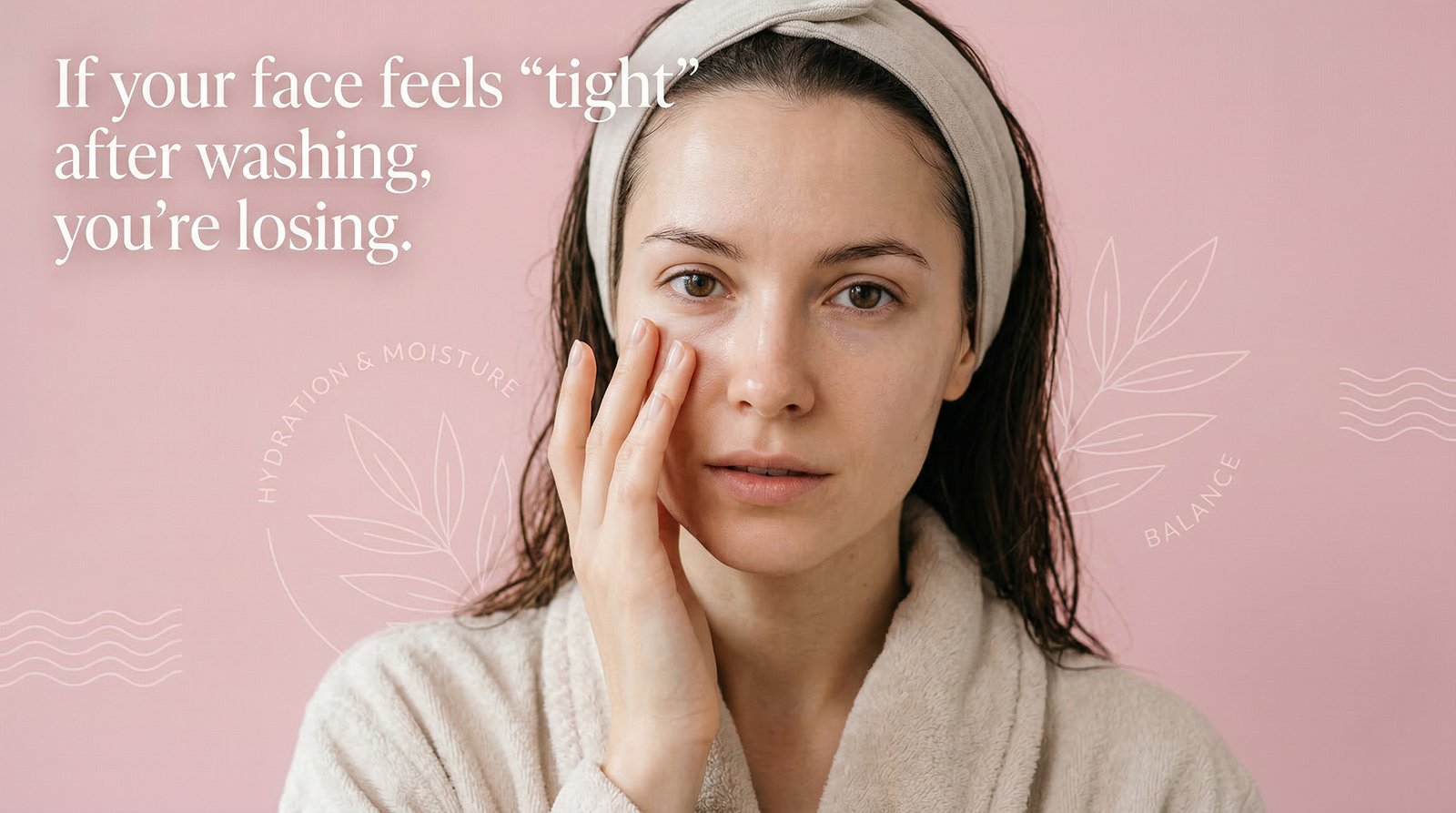
Your “squeaky clean” face isn’t a sign of purity; it’s the sound of your skin barrier losing the lipids it needs to protect you from chronic inflammation loops.
The "Clean" Feeling is Actually a Structural Failure
Your current cleanser is likely the loudest thing in your routine, and that’s a problem. If your face feels tight, “squeaky,” or look unusually shiny after washing, you aren’t clean.
You’re stripped.
You’ve been taught that a cleanser’s job is to remove everything. But when you remove everything, you lose the very things that keep your skin from falling apart.
The foam is a lie designed for your dopamine
Most people choose a gel because they want that big, bubbly lather. They’ve been conditioned to associate foam with purity.
Biologically, that foam is usually the result of harsh surfactants like SLS or SLES.
These molecules don’t just “grab” dirt. They tunnel into your stratum corneum the outermost layer of your skin and dissolve the lipid matrix. When you dissolve that matrix, you create micro-holes in your defense.
According to research published in the Journal of Investigative Dermatology, disrupting these lipids leads to an immediate spike in transepidermal water loss (TEWL).
Your skin isn’t “fresh.” It’s leaking.
Why your "deep clean" is actually triggering more oil
If you have oily skin, you probably reach for the most aggressive gel you can find.
You want to “kill” the shine.
But your skin is smarter than your marketing department. When you strip away every trace of sebum, your skin registers a state of emergency. It interprets the dryness as a lack of protection and signals your sebaceous glands to go into overdrive. You wash more to fix the oil. The skin produces more oil to fix the wash. You are trapped in an inflammation loop that you are funding with your own paycheck.
The milk transition isn't about "gentleness" it's about biology
Skincare “milks” or cream cleansers are often dismissed as being for “dry” or “sensitive” types. That’s a narrow way to look at a formulation. A well-made milk cleanser uses oils and fatty alcohols to bind to impurities. It mimics the skin’s natural composition. Instead of ripping the door off the hinges, it slides the mail through the slot.
At “Minimals”, we don’t believe in the “strip and repair” cycle.
We believe in a cleanser that respects the microbiome from the first second. If your cleanser isn’t putting back more than it takes out, it shouldn’t be in your bathroom.
Your microbiome is currently being evicted
You aren’t just a person, you’re an ecosystem.
Millions of bacteria, fungi, and microbes live on your skin surface, acting as a living shield. They thrive in a specific, slightly acidic pH usually between 4.5 and 5.5. Most mass-market gel cleansers are alkaline. When you shift that pH, you kill off the “good” bacteria and roll out the red carpet for C. acnes and other pathogens. This is why you get breakouts that never seem to clear up. It isn’t a “hormonal” issue; it’s a housing crisis for your microbes.
The NIH has highlighted how a disrupted microbiome is a direct precursor to chronic inflammatory conditions.
Stop treating your face like a countertop that needs disinfecting.
It’s a garden.
The "Squeaky Clean" sound is actually your skin screaming
Listen to your skin after you dry it. If it feels like the skin is two sizes too small for your face, you’ve just caused structural trauma. That “tight” feeling is the result of your skin cells shrinking as water evaporates. This is the “Aesthetic Fatigue” of the skincare world the idea that a product has to hurt or feel “active” to be working.
It doesn’t.
Real results are quiet. Real results look like a barrier that doesn’t react to every change in the weather
The "Hydration" step that's quietly drying you out
You probably use a Hyaluronic Acid serum right after washing.
You think you’re “feeding” the skin. But if your barrier is already compromised by a harsh gel wash, that serum might be doing the opposite.
Hyaluronic acid is a humectant; it pulls moisture from the nearest source. If the air is dry and your barrier is leaky, it will pull water from the deeper layers of your skin to the surface, where it promptly evaporates. You aren’t hydrating. You’re dehydrating from the inside out. This is why we focus on serums that prioritize barrier-first ingredients like ceramides and fatty acids. You need to seal the floor before you try to mop it.
Stop trying to "help" the healing process
You see a tiny whitehead and decide to “help” it by using a physical scrub or a pore strip.
Congratulations. You’ve just turned a 3-day blemish into a 14-day red crater. Mechanical stress on an inflamed pore is like throwing gasoline on a fire. You’re causing post-inflammatory hyperpigmentation (PIH) that will take months to fade, all for a 10-second hit of dopamine. Your skin knows how to heal. Your only job is to stop getting in its way.
The Skinimalism Blueprint: 3 Steps that Actually Work
You don’t need a 10-step “comprehensive” routine. You need a strategy that recognizes your skin as a living organ.
Discard the foam. Use a cleanser that feels like a lotion. Apply to dry skin, massage, and rinse with lukewarm water. If your water is too hot, you’re melting your natural lipids. Stop it.
Apply a serum that reinforces the lipid matrix. Look for Niacinamide to regulate oil and Ceramides to “glue” your skin cells back together. Do this while the skin is still slightly damp. This is “moisture sandwiching” in its most effective form.
Finish with a moisturizer that acts as a second skin. It should be occlusive enough to stop TEWL but breathable enough to let the microbiome breathe.
You don’t need more products; you need fewer that work
The skincare industry is built on the idea that your skin is “broken” and needs a dozen different chemicals to fix it.
It’s a lie.
Your skin is a self-regulating masterpiece that has been overwhelmed by too much “help.”
At “Minimals”, we don’t make products for the shelf. We make them for the biology.
Stop guessing with every new “game-changer” that pops up on your feed.
Your skin isn’t a trend. It’s an investment.
Ready to stop the inflammation loop? Explore the Minimals collection.
A simple "Cleansing" checklist
Frequently Asked Questions
That tightness is a signal of barrier damage. It means your cleanser was too aggressive and triggered transepidermal water loss (TEWL) by stripping away your protective lipids.
Yes, if it’s formulated with authority-led chemistry. A cream or milk cleanser uses fatty acids to dissolve debris without the structural trauma caused by high-foam surfactants.
Usually the opposite. By stopping the inflammation loop and respecting your microbiome, your skin finally settles into a state of metabolic beauty where it stops overproducing oil in a panic.
Never. Squeaky skin is skin that has had its lipid matrix dissolved. If you can hear your skin, you’ve just evicted your natural defenses and invited irritation.
If you deal with persistent redness, sudden sensitivity, or “hormonal” acne that never heals, your skin biology is likely out of balance from over-cleansing and disinfection-style routines.
Closing thought
The skincare industry has spent decades selling you a feeling of “purity” that is actually skin barrier destruction in disguise. In 2026, the shift toward high-fidelity aesthetics and metabolic beauty means moving past the satisfying foam and into authority-led chemistry. Your skin doesn’t need to be “cleared” it needs to be supported. By ending the cycle of aesthetic fatigue and respecting your skin biology, you stop treating symptoms and start building resilience. True skinimalism isn’t about doing less; it’s about doing exactly what your barrier requires to function without constant inflammation loops.
Stop participating in a routine that treats your face like a DIY project. It’s time to lean into a system that prioritizes barrier repair and long-term health over a ten-second “squeaky clean” hit of dopamine.
Ready to exit the strip-and-repair cycle? Discover the authority-led difference at Minimals.
Your “squeaky clean” face isn’t a sign of purity; it’s the sound of your skin barrier losing the lipids it needs to protect you from chronic inflammation loops.
The "Clean" Feeling is Actually a Structural Failure
Your current cleanser is likely the loudest thing in your routine, and that’s a problem. If your face feels tight, “squeaky,” or look unusually shiny after washing, you aren’t clean.
You’re stripped.
You’ve been taught that a cleanser’s job is to remove everything. But when you remove everything, you lose the very things that keep your skin from falling apart.
The foam is a lie designed for your dopamine
Most people choose a gel because they want that big, bubbly lather. They’ve been conditioned to associate foam with purity.
Biologically, that foam is usually the result of harsh surfactants like SLS or SLES.
These molecules don’t just “grab” dirt. They tunnel into your stratum corneum the outermost layer of your skin and dissolve the lipid matrix. When you dissolve that matrix, you create micro-holes in your defense.
According to research published in the Journal of Investigative Dermatology, disrupting these lipids leads to an immediate spike in transepidermal water loss (TEWL).
Your skin isn’t “fresh.” It’s leaking.
Why your "deep clean" is actually triggering more oil
If you have oily skin, you probably reach for the most aggressive gel you can find.
You want to “kill” the shine.
But your skin is smarter than your marketing department. When you strip away every trace of sebum, your skin registers a state of emergency. It interprets the dryness as a lack of protection and signals your sebaceous glands to go into overdrive. You wash more to fix the oil. The skin produces more oil to fix the wash. You are trapped in an inflammation loop that you are funding with your own paycheck.
If you have oily skin, you probably reach for the most aggressive gel you can find.
You want to “kill” the shine.
But your skin is smarter than your marketing department. When you strip away every trace of sebum, your skin registers a state of emergency. It interprets the dryness as a lack of protection and signals your sebaceous glands to go into overdrive. You wash more to fix the oil. The skin produces more oil to fix the wash. You are trapped in an inflammation loop that you are funding with your own paycheck.
How to handle it
Fixing this doesn’t require a complicated 12-step routine.
In fact, it requires doing less.
If you want to stop the “tightness” and start winning the skincare game, here is a calm, practical way to handle it:
Hot water is a master at stripping oil. Switch to lukewarm water, it’s much gentler on your barrier.
You don’t need to wash your face three times. One gentle, effective wash is usually plenty.
You don’t need spinning brushes or rough washcloths. Your clean fingertips are the gentlest tool you own.
When you dry your face, gently pat it with a soft towel. Leave it just a tiny bit damp.
Don’t wait twenty minutes. Apply your moisturizer while your skin is still slightly damp to “lock in” that hydration.
A gentle way to cleanse
If your current cleanser is leaving you feeling like a drumhead, you might want to try our Triple Action Cleanser.
We made it specifically for people who are tired of that “stripped” feeling.
It doesn’t foam up into a giant mountain of bubbles, because honestly, bubbles are usually just harsh detergents (sulfates) that do more harm than good.
Instead, it feels more like a soft, silky lotion.
It lifts away the grime and the makeup, but it leaves your “moisture cape” exactly where it belongs.
When you rinse it off, your face feels like… well, skin. Not paper. Not plastic. Just soft, clean skin.
Common mistakes we all make
We’ve all been there, but these are the big ones that usually lead to that tight feeling:
A simple "Barrier First" checklist
Frequently Asked Questions
Run your clean finger over your nose or chin. If it feels smooth and there’s no visible makeup or “grime” on your finger, you’re clean. You don’t need to feel a pull to be hygienic.
It’s fine, as long as you aren’t putting your face directly under the high-pressure, hot stream. Try to wash your face at the very end of your shower using the cooler water from the tap if possible.
Actually, it’s worse for you. When you strip oily skin, you trigger “reactive seborrhea”, your skin overproduces oil to protect itself. A gentle wash will actually help balance your oil production over time.
Yes, quite a bit. Your skin is naturally slightly acidic. Most harsh cleansers are very basic (alkaline). This shift in pH makes it easier for bad bacteria to grow, which leads to breakouts.
It might be your water. If you live in an area with “hard water” (lots of minerals), those minerals can stay on your skin and feel stiff. Try using a gentle, alcohol-free toner or just a high-quality moisturizer on damp skin.
Closing thought
There are so many acids, peels, and “deep cleansers” that it’s easy to feel like we need to be aggressive to see results.
But your skin is a living organ, not a kitchen counter. It doesn’t need to be bleached or scrubbed into submission.
If you take just one thing away from our chat today, let it be this:
Respect your barrier.
When you stop fighting your skin and start working with it, everything gets easier:
The redness fades.
The breakouts calm down.
The glow comes back.