
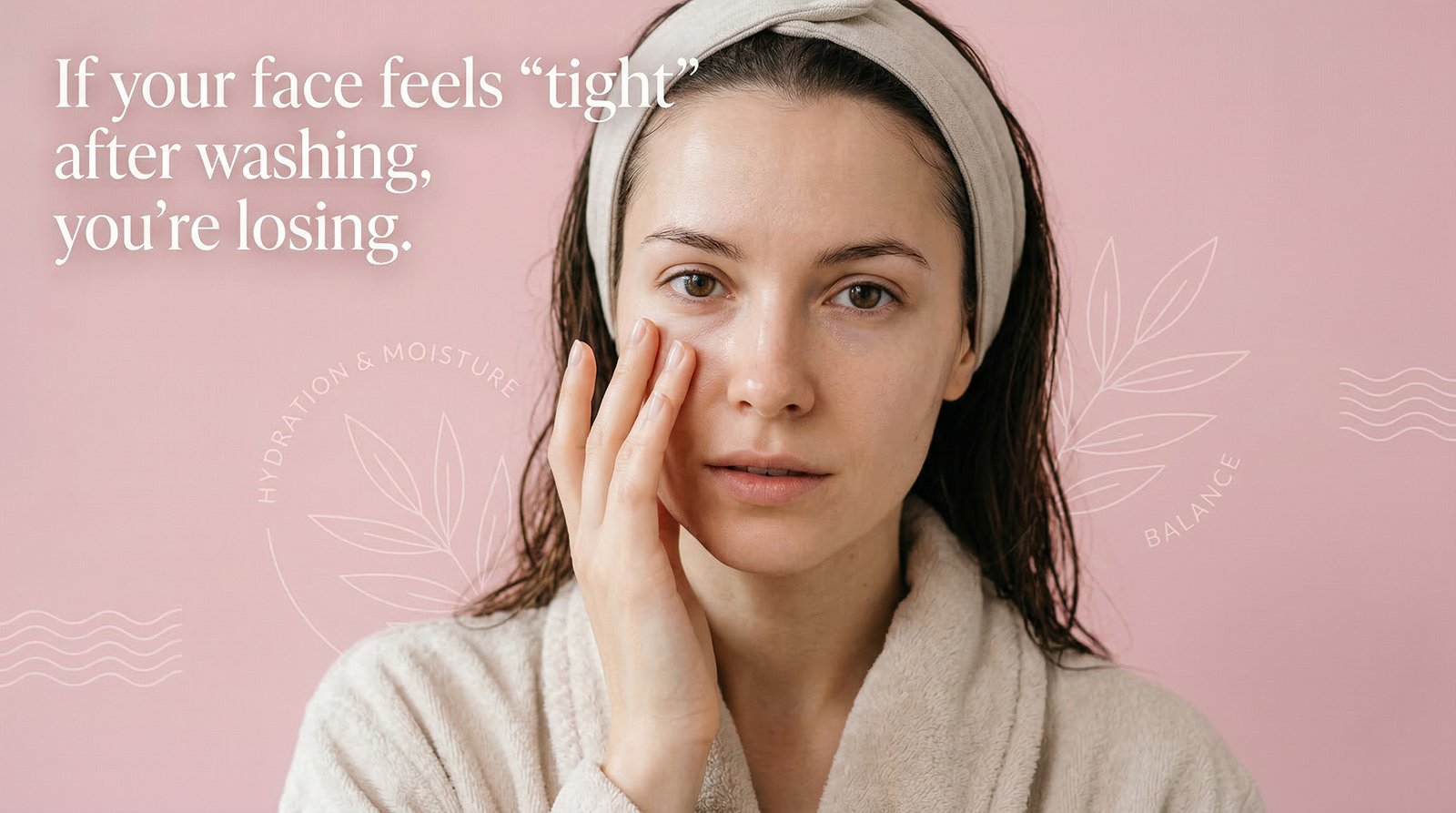
Because your skin barrier thrives on precision, not pollution streamline your routine to just eight high-performance steps that deliver maximum radiance with minimal effort.
Stop Suffocating Your Skin Barrier
Your 10-step routine isn’t helping your skin. It’s exhausting it. Not metaphorically. Literally. Every extra product you apply is another variable your skin barrier has to negotiate another pH shift, another preservative, another emulsifier that wasn’t designed to coexist with the three serums you layered before it.
The result? Redness that wasn’t there before. Breakouts you blame on stress. Sensitivity that seems to come from nowhere. And a bathroom shelf that keeps growing, because the answer to skin problems has somehow always been more product. It hasn’t been working. You know it hasn’t been working. And somewhere between the fifth serum and the third toner, you started to wonder if you were the problem.
You’re not. The routine is.
The Thing Nobody Tells You About "More" Skincare
Your skin barrier the outermost layer that keeps moisture in and irritants out is not a wall. It’s a living matrix of ceramides, fatty acids, and cholesterol, held together by something researchers call the lipid bilayer. When it’s intact, your skin looks calm, plump, and resilient. When it’s damaged, it doesn’t look like anything specific. It just looks… off.
Here’s what wrecks it: over-cleansing, layering actives that don’t belong together, and constantly introducing new products that shift the skin’s pH and disrupt its microbiome the community of bacteria that lives on your skin and actively helps regulate inflammation and immunity.
Most skincare routines are, without meaning to be, barrier demolition projects.
The Science A 2021 study in the Journal of Investigative Dermatology found that transepidermal water loss (TEWL) the rate at which your skin leaks moisture increases significantly with repeated surfactant exposure. Translation: every unnecessary cleansing step is making your skin drier than it was before you “hydrated” it.
This is the loop nobody talks about: you strip your barrier, your skin gets reactive, you apply more product to fix it, that product strips it further, and you interpret the whole cycle as “my skin is just difficult.” It isn’t. It’s responding rationally to what you’re doing to it.
Why "Less, But Better" Is Not a Trend. It's Dermatology.
Skinimalism the practice of using fewer, more intentional products didn’t come from Instagram. It came from the same place every sensible skincare principle comes from: the understanding that skin is not passive. It regulates itself. It produces its own lipids. It maintains its own pH. It communicates through inflammation when something is wrong. Your job is not to do more to your skin. Your job is to stop doing things that interfere with what it already knows how to do.
That’s the shift. And the eight steps below are how you actually make it.
Step 01: Your Cleanser Might Be Causing the Breakouts You Blame on Hormones
Cleansing is the step most people do twice a day without ever questioning whether their cleanser is appropriate for their skin. And most of them are using something too stripping.
Sodium lauryl sulfate (SLS) and similar surfactants are effective at removing oil so effective that they take your skin’s natural lipid layer with them. What follows is that tight, squeaky-clean feeling that the industry spent decades teaching you to interpret as “clean.” It’s not clean. It’s compromised.
Research published in PubMed consistently shows that harsh surfactants increase TEWL and disrupt the microbiome, setting off the inflammation loop described above. You’re not clearing your pores. You’re priming your skin to be reactive to everything else you apply afterward.
“A cleanser that leaves your skin feeling tight has already failed.”
The right cleanser should feel like nothing. Mild, low-pH, non-foaming if your skin is dry or sensitive. It should remove what needs to be removed and leave everything else exactly where it is.
What this looks like in practice
At this point, your routine needs a cleanser that respects the barrier it’s cleaning. Not a stripping foam. Not a “deep pore” anything. Something gentle enough to use daily without consequence.
Step 02: You Are Almost Certainly Over-Cleansing
Twice a day. Every day. Even on days when you haven’t worn makeup. Even on days when you went nowhere. This is the default, and the default is wrong for a lot of skin types.
If your skin is dry, sensitive, or prone to redness, your AM cleanse might be doing nothing except removing the oils your skin produced overnight to repair itself. Those oils are not dirt. They’re not something you need to wash off. They’re part of the repair process.
Try rinsing with lukewarm water in the morning. Give it two weeks. Watch what happens.
Step 03: Hydration ≠ Moisture. Getting This Wrong Ruins Everything After It.
This is the counterintuitive one. Hydration and moisture are not the same thing, and conflating them is why so many people spend a fortune on “hydrating” products and still feel dry.
Hydration is water content the amount of water held within your skin cells. Moisture is about occlusion your skin’s ability to keep that water from escaping. You can have perfectly hydrated skin and still lose that hydration within hours if your lipid barrier is compromised. The water just leaves. This is why hyaluronic acid the hero ingredient in a thousand hydrating serums can actually make your skin drier if you live in a low-humidity environment and don’t follow it with something occlusive. It draws moisture from the deeper layers of your skin to the surface, and then, if there’s nothing to seal it in, it evaporates. You’ve effectively dehydrated yourself from the inside out.
Wait What?
Applying hyaluronic acid without a moisturizer afterward in a dry climate can increase water loss from the skin. The NIH-cited concept of TEWL explains this: without an occlusive or emollient layer, humectants like HA can pull moisture to the surface only for it to escape into the air. Always seal your hydration.
The fix is simple: moisture sandwiching. Apply your water-based hydration, then immediately layer something emollient or occlusive on top to trap it. Don’t wait for the first layer to dry. Keep it damp. Then seal.
Step 04: The "Hydration" Step That's Quietly Drying Your Skin Out
Toner. Specifically, the alcohol-based kind, or the kind marketed as “exfoliating” or “clarifying.” These products account for an embarrassing amount of the barrier damage I see in routines that otherwise look thoughtful. The logic was sound once: balance pH after cleansing, prep skin for the next step. But if your cleanser is already pH-balanced, you don’t need a toner to correct it. And if your toner contains ethanol, witch hazel, or acids you haven’t calibrated to your skin’s tolerance you’re just adding a stripping step where none was needed.
Ask yourself: if I removed my toner, what would I lose? If the honest answer is “I don’t know,” remove it for a month and find out.
Step 05: Stacking Actives Isn't Advanced Skincare. It's Usually the Problem.
Retinol in the evening. Vitamin C in the morning. Niacinamide in the middle. AHA on alternating nights. Peptides whenever there’s space. Sound familiar?
This is what the skincare content ecosystem has normalized building routines around individual ingredients as if skin is a chemistry experiment rather than an organ with a finite tolerance for intervention. What actually happens when you layer too many actives: skin pH fluctuates constantly, making actives less effective and skin more reactive. Certain combinations vitamin C and niacinamide, for instance, or retinol and AHAs can irritate or simply cancel each other’s efficacy. And the inflammation loop starts again, this time triggered by your “treatment” routine.
Dermatology Times has repeatedly flagged that the risk of active stacking is cumulative irritation a slow build that doesn’t announce itself until you’re dealing with persistent redness, sensitivity flares, or PIE that won’t resolve.
“One well-formulated active used consistently will outperform five mediocre ones used simultaneously.”
Pick one active that addresses your primary concern. Use it correctly right frequency, right pH, right skin state. Give it 12 weeks before adding anything else.
The smarter approach
Your skin doesn’t need another step. It needs a formula that’s already done the layering for you actives calibrated to work together, at concentrations that treat without triggering. That’s not compromise. That’s formulation intelligence.
Step 06: Your Moisturiser Isn't Working If Your Barrier Is Broken
Moisturiser applied to a damaged barrier is like painting a wall with cracks in the plaster. You can layer it on. The cracks will still show through. Before you can benefit from a moisturiser’s film-forming or humectant properties, your barrier needs to be functional enough to respond. That means ceramides. Specifically, the three ceramide types ceramide 1, 3, and 6-II that mirror what’s naturally found in the human lipid matrix.
Research from the NIH shows that ceramide-depleted skin has significantly higher TEWL and greater inflammatory response to external triggers. Replenishing ceramides isn’t optional if you have reactive or dry skin. It’s foundational.
Look for moisturisers that combine ceramides with a humectant (glycerin or hyaluronic acid) and an emollient (fatty acids, squalane). That three-part structure humectant, emollient, occlude is what a moisturiser actually needs to do to keep your barrier functional overnight.
What barrier-first looks like A moisturiser built around ceramide replenishment and barrier support not fragrance, not filler, not twelve ingredients you can’t pronounce. The kind of formula that works quietly and lets your skin do the rest.
Step 07: SPF Is the Only Anti-Ageing Product With Actual Evidence Behind It
UV exposure accounts for roughly 80% of visible skin ageing the statistic has been consistent across multiple peer-reviewed studies, including a landmark twin study in which lifetime sun exposure explained the majority of perceived age difference between identical twins.
Your retinol, your vitamin C, your peptide serum all of it is working against UV damage if you’re not blocking it first. SPF is not a bonus step. It’s the prerequisite that makes every other step in your routine matter.
Daily. Year-round. Even indoors near windows. And yes, even on days when it’s overcast. UVA penetrates cloud cover.
Step 08: If Your Routine Feels Complicated, That Is the Problem
There’s a version of skincare enthusiasm that tips over into something that no longer has anything to do with your skin. It becomes a hobby, a collection, a response to anxiety. You know you’ve crossed that line when your routine is harder to maintain than a sleep schedule or a water intake goal.
Complicated routines fail for the same reason complicated diets fail: consistency requires simplicity. The routine you’ll actually do every day is always more effective than the optimised one you abandon three times a week.
If you can’t describe your routine in four steps, it probably has at least two steps that don’t belong there.
The Minimal Routine Blueprint
Gentle, pH-balanced, surfactant-appropriate for your skin type. Not foaming if you’re dry. Not oil-only if you’re acne-prone. The goal is a clean canvas without collateral damage. Try “Minimals’ Gentle Barrier Cleanser it removes without resetting your skin to zero.
One active. Targeted to your actual skin concern, not your aspirational skin concern. Retinol for texture and aging. Niacinamide for redness, sebum regulation, and barrier support. Vitamin C for oxidative stress and hyperpigmentation in the morning. Not all three at once.
An emollient-rich moisturizer that contains ceramides, fatty acids, or both. This is non-negotiable. This is where you complete the moisture sandwich and protect the treatment you just applied from evaporating into the air.
“Minimals” Ceramide Barrier Moisturizer uses a lipid-replenishing blend built around the skin’s own ratio of ceramides, cholesterol, and fatty acids the same ratio your barrier is already trying to maintain.
Broad-spectrum SPF 30 minimum. This is not optional. Photoaging accounts for roughly 80 to 90% of visible skin aging, and research from the NIH confirms that daily sunscreen use significantly reduces cumulative UV-induced damage over time. Everything else you do in your routine is partly undone if you skip this step.
Common mistakes we all make
Stacking individual ingredient serums (Vitamin C + Niacinamide + Retinol + AHAs) shifts your skin’s pH constantly. Instead of delivering advanced results, it creates cumulative irritation and cancels out product efficacy.
Using harsh, foaming surfactants (like SLS) strips the lipid bilayer the vital matrix of ceramides and fatty acids. If your skin feels tight or “squeaky” after washing, you haven’t cleared your pores; you’ve just damaged your barrier.
Applying a humectant like Hyaluronic Acid in a dry environment without immediately sealing it with an emollient or occlusive moisturizer. Without a “moisture sandwich,” HA pulls water up from the deeper layers of your skin only for it to evaporate into the air.
Washing your face with a cleanser twice a day out of habit, even when you haven’t worn makeup or left the house. For dry or sensitive skin, an AM cleanse strips away the beneficial oils your skin produced overnight to actively repair itself.
Using alcohol-based, exfoliating, or clarifying toners to “balance pH” when your modern cleanser is already pH-balanced. If your toner contains ethanol or uncalibrated acids, it’s an unnecessary stripping step that disrupts the microbiome.
A simple "Keep or Cut" checklist
Frequently Asked Questions
Yes. Over-cleansing often triggers excess oil production; a simpler routine repairs the barrier and reduces reactive breakouts.
Not necessarily. Keep one active that targets your primary concern and stop layering multiple treatments simultaneously.
You likely aren’t sealing the moisture. Always apply an emollient or ceramide-rich moisturizer over damp, hydrated skin.
If your skin is dry or sensitive, yes. Rinsing with water protects the lipids your skin produced overnight for repair.
The skin cycle takes about 28 days. Give your simplified routine at least one full cycle to show true improvement.
Closing thought
Your skin is an organ, not a battlefield. It doesn’t need to be forced into submission with a rotating gallery of products; it needs to be given the space to do what it was biologically designed to do. Radical improvement doesn’t start when you buy your next bottle. It starts when you trust your skin’s intelligence enough to step away from the clutter.